



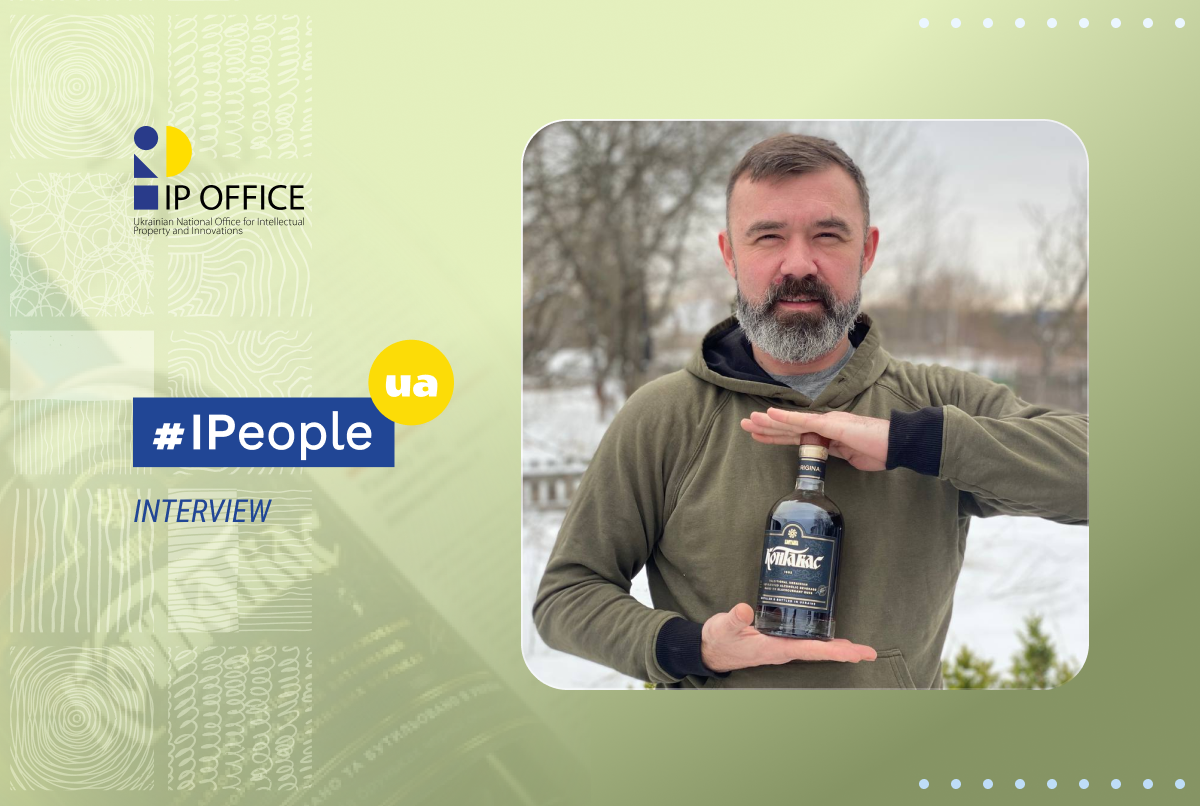
Today, Roman Pelekh is reviving an ancient Ukrainian beverage – kontabas, which has the potential to become a Ukrainian geographical indication.
As part of the IPeopleUA project, our guest spoke about his journey from an accidental discovery of kontabas to building a business, about researching historical sources, the challenges of craft production and promoting a unique product. He also shared how registering a brand and an original label design becomes a form of insurance for a business and why abandoning the production of kontabas would mean betraying Ukrainian cultural heritage.
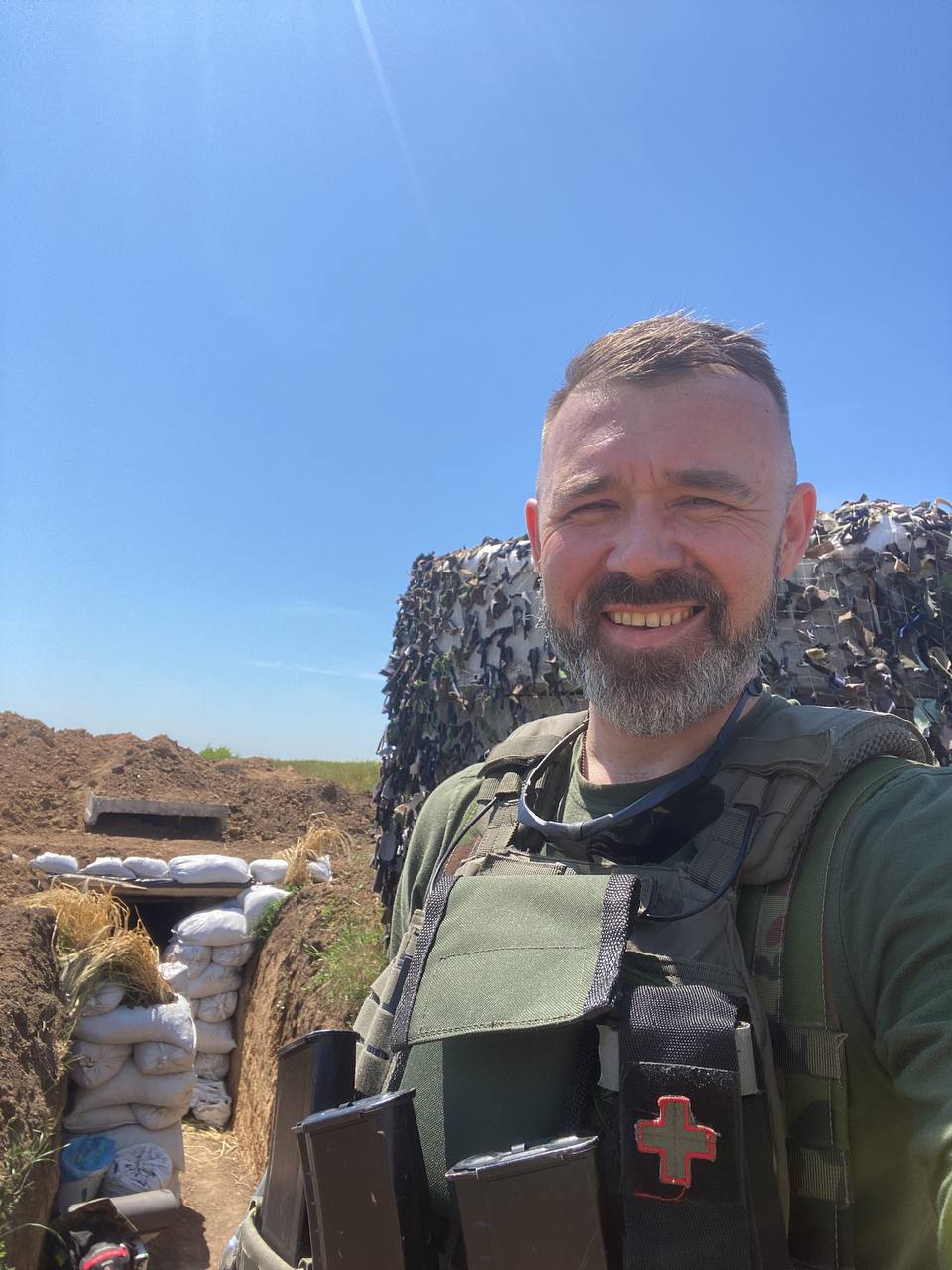
Roman Pelekh – veteran of the Armed Forces of Ukraine, founder of the Kontapel brand
– Roman, the story of your discovery of kontabas in one of the villages in Zakarpattia already sounds like a ready-made film script. You bought a rural house and discovered a deep cellar, where you found a little over 90 liters of kontabas bottled back in 1993. You also found a notebook with old recipes for various drinks and dishes, including kontabas. You must have been euphoric about the discovery. When did you realize that producing kontabas could become a business?
– In fact, there wasn’t much euphoria at that moment. The euphoria came later, when we found out what kontabas actually was. When we started working with archives and discovered that it is an old Ukrainian beverage – a distillate made from currant buds, which used to be quite popular and even folk songs were written about it. That’s when it really struck us.
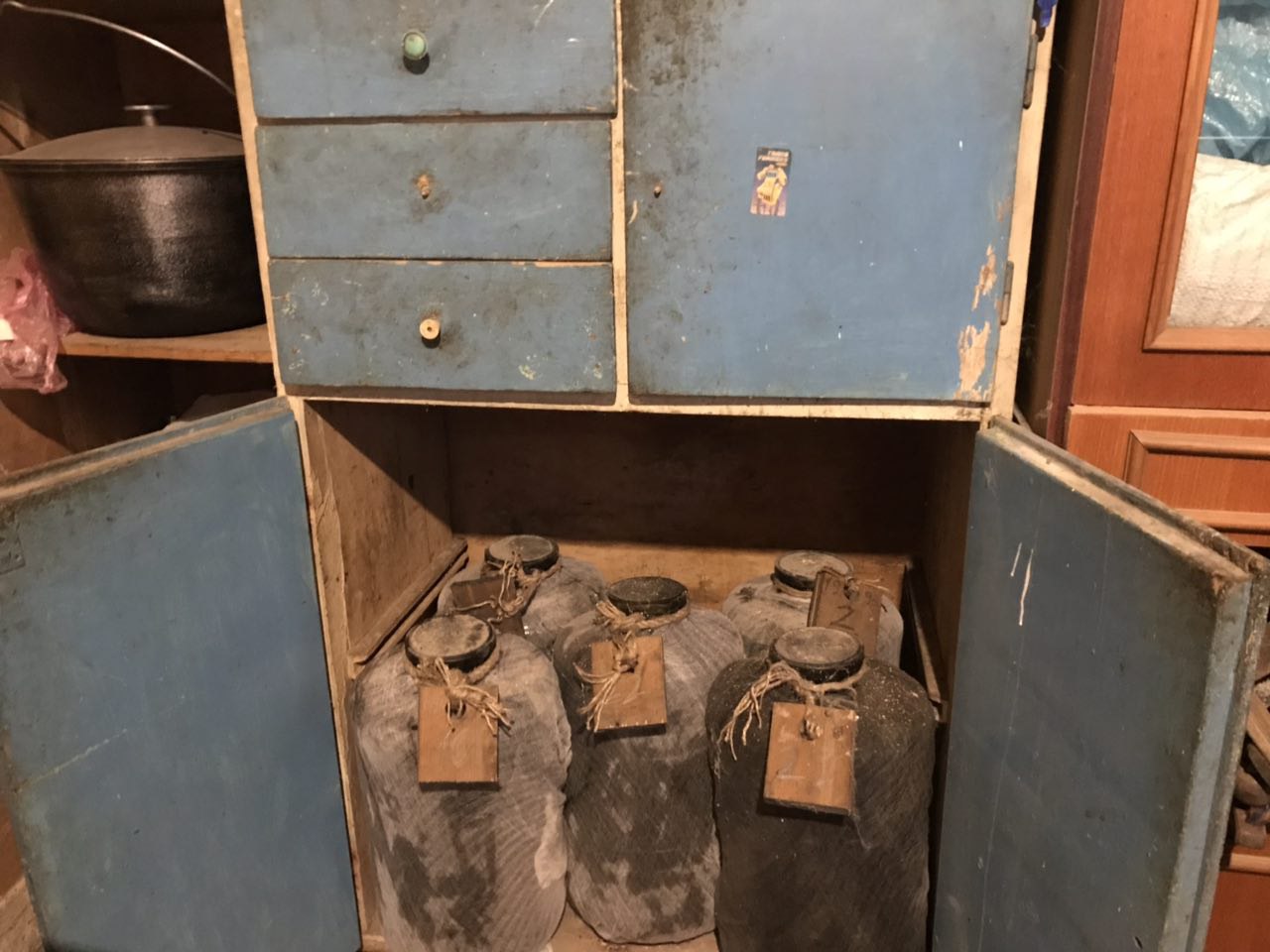
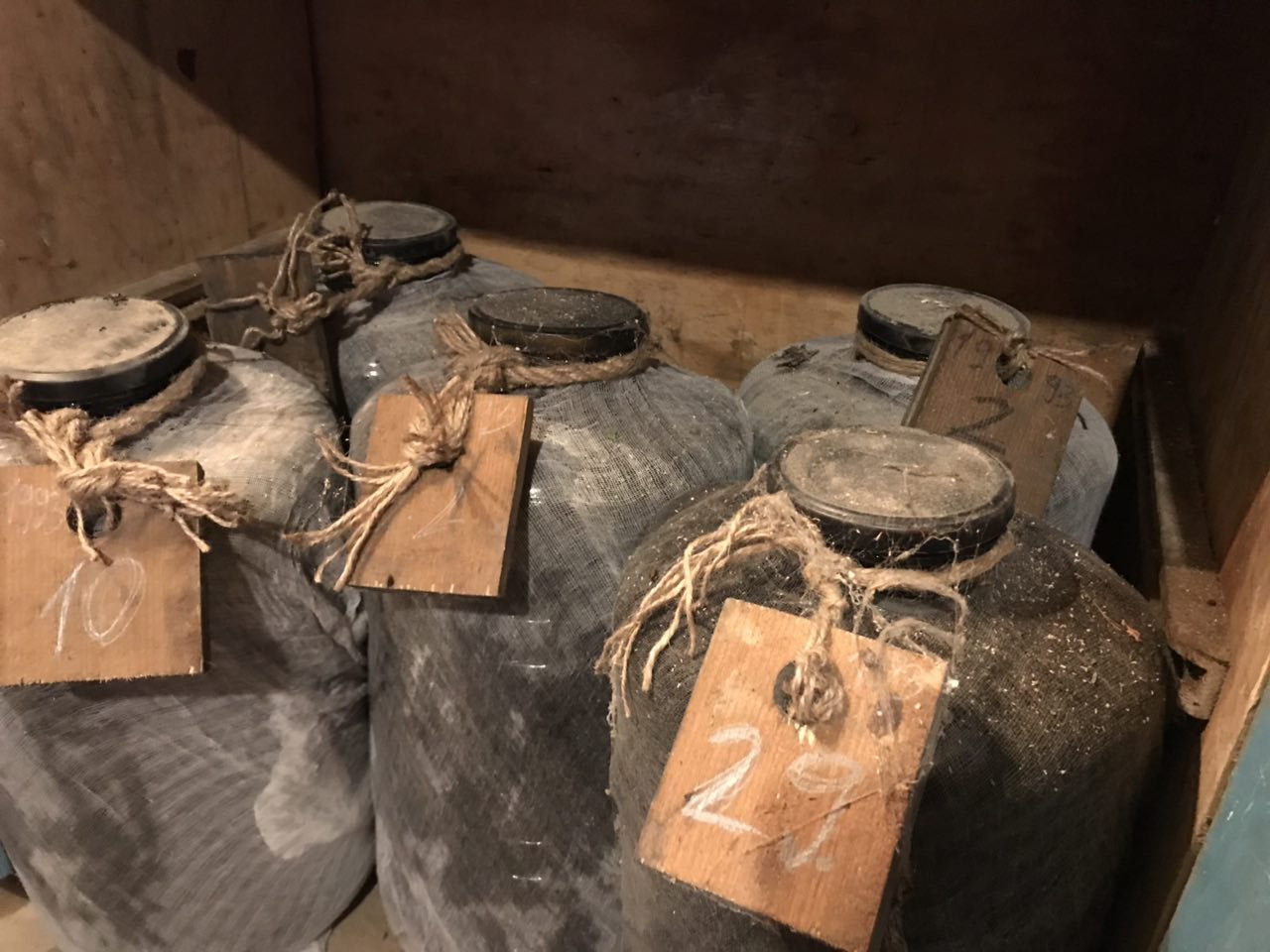
That same kontabas from the cellar where more than 90 liters of the beverage were found
But information about kontabas revealed itself to us gradually. First, we found a mention in one of the earliest Ukrainian cookbooks by Zynoviia Klynovetska, “Dishes and Drinks in Ukraine” (1913).
When did I decide to turn it into a business? At the beginning, it wasn’t about business at all. I wanted Ukrainians to regain their memory – for all of us to remember that we once had our own alcoholic beverage, just like the Scots have whisky and the French have cognac.
Our first batch was very limited – up to 400 bottles. It was more of an introductory story. About 30% of the blend was the old aged kontabas we had found, and the rest was newly produced by us.
We sold the bottles for 4,500 hryvnias – and sold out everything within six months. That was when I realized this was worth pursuing seriously: to calculate an economically justified price and set it at a level people could afford.
When I heard the first feedback and saw how people perceived the beverage, it was a pleasant shock for me that people were willing to pay a bit more – not only for the beverage itself, but also for the story behind it.
– So before this discovery, you had never even heard the word “kontabas”? Did you start googling it or go straight to archives?
– I started by googling different variations of the word – “kontabas”, “kantabas”, “konobas”, because the product name differed across regions of Ukraine. I went all the way to the last pages of Google search results.
I also worked with online archives – there are resources where digitized old newspapers and documents are available. I read old newspapers hoping to find any mention of kontabas and I found one in the newspaper Rada from 1913.
After the first discovery, I spent about a year gathering information piece by piece. In fact, there are not many references, but they are very telling.
For example, in Borys Hrinchenko’s Dictionary of the Ukrainian Language, it says: “If one drinks kantabas, one becomes intoxicated,” with a reference to Pavlo Chubynskyi. We started looking into Chubynskyi’s works – it wasn’t easy, but we found it. And there, kontabas is mentioned in the context of folk songs. We realized that if people sang about kontabas, it must have been popular. And not just for decades – most likely for centuries.
– So now do you feel that your business is also a cultural mission to revive Ukrainian heritage?
– That’s exactly what it is. That’s where it all began. I invested money from my previous business into this project as a hobby – to tell people about Ukrainian beverages and our history.
By the way, Klynovetska’s collection contains many more beverages – there are a lot of them. It just so happened that I came across kontabas and that’s what I started developing.
But if you look more broadly, there are hundreds of interesting beverages, each with its own story: pepper vodka, spotykach, tabakivka…
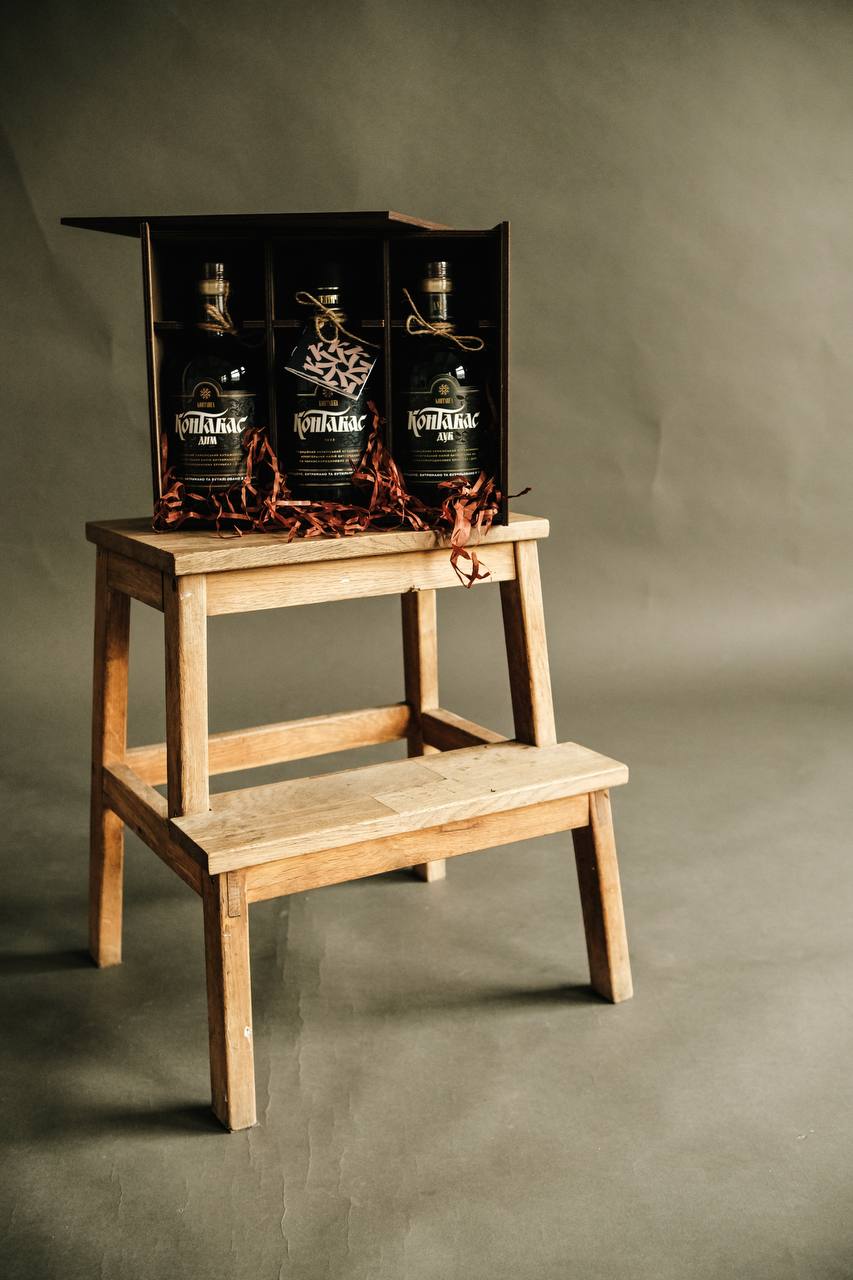
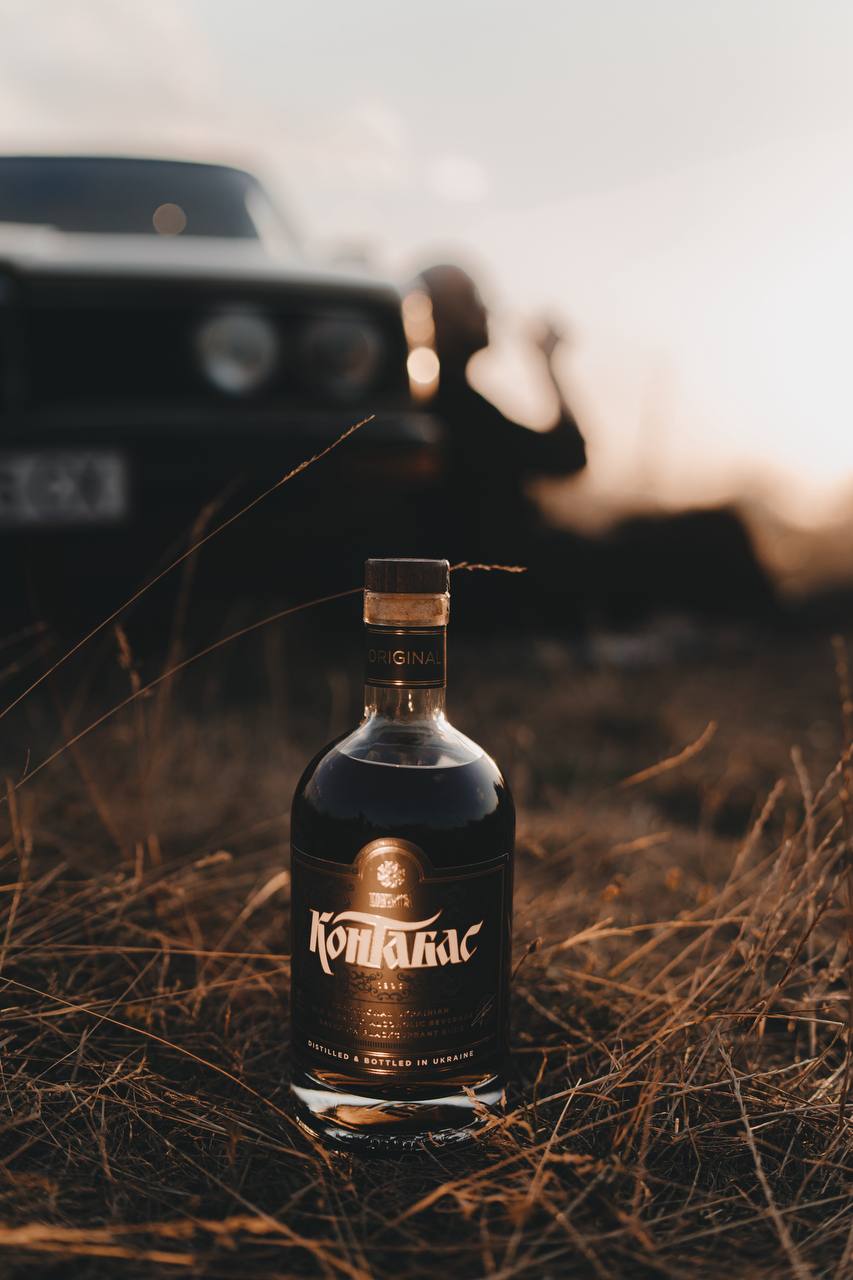
– Have you considered expanding the project and producing other historical beverages?
– Yes, of course. We are gradually moving in that direction. For example, we now have a project called “Smoked Pear” together with Yevhen Klopotenko. We have already signed an agreement and are planning the launch. This is also an old Ukrainian beverage, but it’s Mr. Klopotenko’s development: he researched it, popularized it and created the recipe. We will produce this beverage at our facility. It is a liqueur (around 30%) – soft, sweet and pleasant in taste.
In general, we have several more beverages in our plans. But launching each one is a complex process: a lot of documentation, production nuances, plus marketing and communication with consumers. It’s not easy to launch. That’s why we are moving gradually, step by step, but we are definitely planning to bring other traditional Ukrainian beverages into production.
– How difficult is it to run a business with such a “historical flavor”? What specific features would you highlight?
– We deliberately limit our audience and that is our choice. In fact, we have three main sales directions for kontabas.
The first is gift purchases: people buy the product as a gift. There was even a case when a person couldn’t afford kontabas for themselves but bought it as a present.
The second is enthusiasts of interesting beverages – people who try different flavors and collect beverages.
And the third is nationally conscious Ukrainians – people who are interested in Ukrainian history and traditions and who support Ukrainian products. For example, our family tries to buy everything Ukrainian – clothing and other goods as well.
We have already launched a new beverage – “Konta.” It is a distillate made using currant buds that have already been used in the production of kontabas. So it is a different product, not kontabas.
It is cheaper to produce, so the price is more affordable – to attract consumers and give them a chance to try it. It works as a first step: a person tries “Konta,” likes it and then becomes interested in “Kontabas.”
– And how is the balance between supply and demand now?
– Previously, demand significantly exceeded supply. For example, in 2021 we produced 100–200 bottles per month and for us that was a lot. Now we have scaled up: we purchased equipment, refined the technology and today such volumes are literally just a few days of work.
Currently, we can produce approximately 10–15 thousand bottles per month and the license allows up to 30 thousand. So we are already close to our production maximum and can ensure a stable supply.
– Do you already have a practically perfect recipe for kontabas? Or did you modify the recipe you found in the notebook?
– Of course, we refined the recipe. Because producing a high-quality product at scale – so that it doesn’t leave sediment or become cloudy – is already a matter of technology. We worked on refining the technology from 2019 to 2021 and even in 2022 we were still adding improvements.
For example, things like freezing the currant buds, filtration – these were not done in the past when kontabas was made. Filtration did exist, of course, but as it was written in the recipe: pass it through cloth twice – and that’s it.
Now we use specialized filters – and different types of them. We also use a specially prepared distillate. I believe that today our kontabas production technology is 99.99% perfect.
– What was more difficult for you personally: creating the product itself, restoring the technology and recipe, or explaining its value to consumers?
– Both were difficult. We started from scratch. We decided: let’s do it – and we did. It began with basic questions: where to get currant buds? We started searching – googled it – and you simply can’t buy them anywhere. There is no market in Ukraine where you can purchase buds.
We started looking abroad. We found some Himalayan blackcurrant buds. Then we found blackcurrant bud extract in France. We ordered it, brought it in, tried dissolving it at home in distillate or alcohol – it didn’t dissolve. And you don’t understand the point of that extract.
And that’s just the issue of the buds. We hadn’t even reached the production stage yet. What we collected ourselves was only enough for 3–5 bottles. And it was very hard physical work: collecting buds is difficult, it has to be done quickly, in one day. We had no staff – we did everything ourselves. To produce one liter of kontabas, you need half a liter of currant buds.
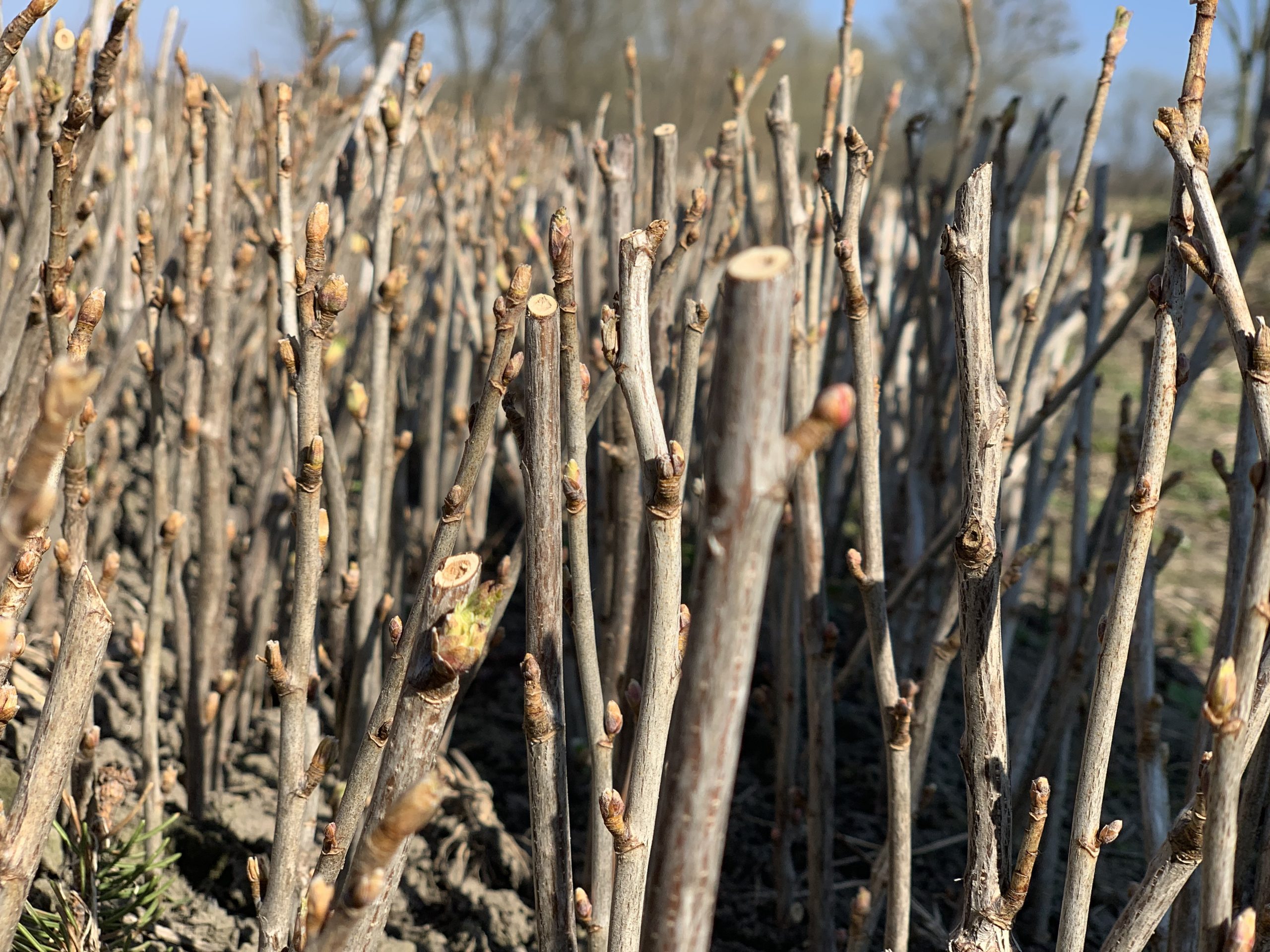
This is what blackcurrant buds look like
– I assume you would need entire plantations of currants to gather that amount.
– Something like that (smiles). In the end, we found two plantations in Zakarpattia – they were essentially abandoned, no one was taking care of them. And there we managed to collect some quantity of buds. But it is hard work.
And that’s just currants, just the buds. Then it gets even more complicated: how to infuse them? With the buds or without? With air exposure or without? With light exposure or without? At what temperature – cold or warm? Infuse in winter or in summer?
All of this is technology and it changes everything. And the hardest part is that once you produce something using a particular method, you only see whether you did it right or wrong after six months or a year. So the task was to create many different versions, record what and how we did and then check the results a year later. And then repeat the process again.
And then there is the issue of corking… There are so many nuances in production.
The same goes for communication: it is difficult for people to understand why they should pay that much money. So we chose this approach: we sold part of the kontabas we had found at a high price so that people would understand its value. Then we sold the fresh kontabas at a lower price. That’s how we built our marketing. But it was very difficult. And it still isn’t easy.
Because, you know, not all French people may like cognac. Some will say, “I don’t like it.” But no French person will write to a producer saying it is a “bad product.”
But in our case, if someone doesn’t like it, they start writing negative comments about a Ukrainian national beverage. But that person is not slapping me – they are slapping themselves as a Ukrainian. There are also people who say: “Why should I pay that much?”
So yes, it is still difficult.
– At such moments, did you ever think about stopping all of this?
– No. Because I make kontabas not for those people, but for those who appreciate it. We have many admirers. Sometimes people even ask to take photos with me on the street – it feels nice. But for me, it’s nothing new: I used to work as a DJ, was somewhat known and people would take photos after performances. So I take it calmly.
But it’s also an indicator. Who am I? I’m just a distiller making kontabas using an old recipe. And if people feel honored to take a photo with me, it means it matters to them. It’s also pleasant for me, because it means I’m not doing this in vain. And there is a group of people who appreciate this work – and express that appreciation financially.
And those who write negative comments may be people who haven’t tasted it, or don’t understand what they’re talking about, or simply don’t care about Ukrainian history.
– At this stage, what “sells” kontabas more – the story or the taste?
– I think that at this stage it’s already the taste. We even had such a moment – it’s not exactly research, but an observation. In 2023, when kontabas had just started being sold, people began writing about it on social media, the first publications appeared, including interviews in the media. And we noticed that it sold best on Saturdays and Sundays.
We understood how it works: people visit each other, put kontabas on the table and talk about it. Some become interested, some don’t. But those who are intrigued end up buying it.
So yes, the story is important – it attracts attention. But for a person to make a purchase, they need to taste it. And if they like the taste, that’s when the purchase happens.
By the way, we are currently working on securing the name “kontabas” exclusively for beverages produced in Ukraine from Ukrainian currant buds – like cognac in the Cognac region of France or champagne in the Champagne province.
– This is a very important step. Geographical indications are registered by the Ukrainian IP Office – applications are submitted there.
– That means I will be going through the IP Office as well. We actually started this process earlier, in cooperation with the then Ministry of Agrarian Policy. We have a whole folder of materials: historical data, comments from people on social media and other documents. A lot of everything.
And behind these materials are real human stories. For example, I really like a post on X (formerly Twitter), where one person asks another: “How did you decide to buy such an expensive beverage?” And the other replies: “All my life my grandmother told me: we were not wealthy – we didn’t drink kontabas. I didn’t know what it was and now I saw it and understood.”
There are many such stories: grandfathers, grandmothers, great-grandparents told that such a beverage existed. And that’s really amazing.
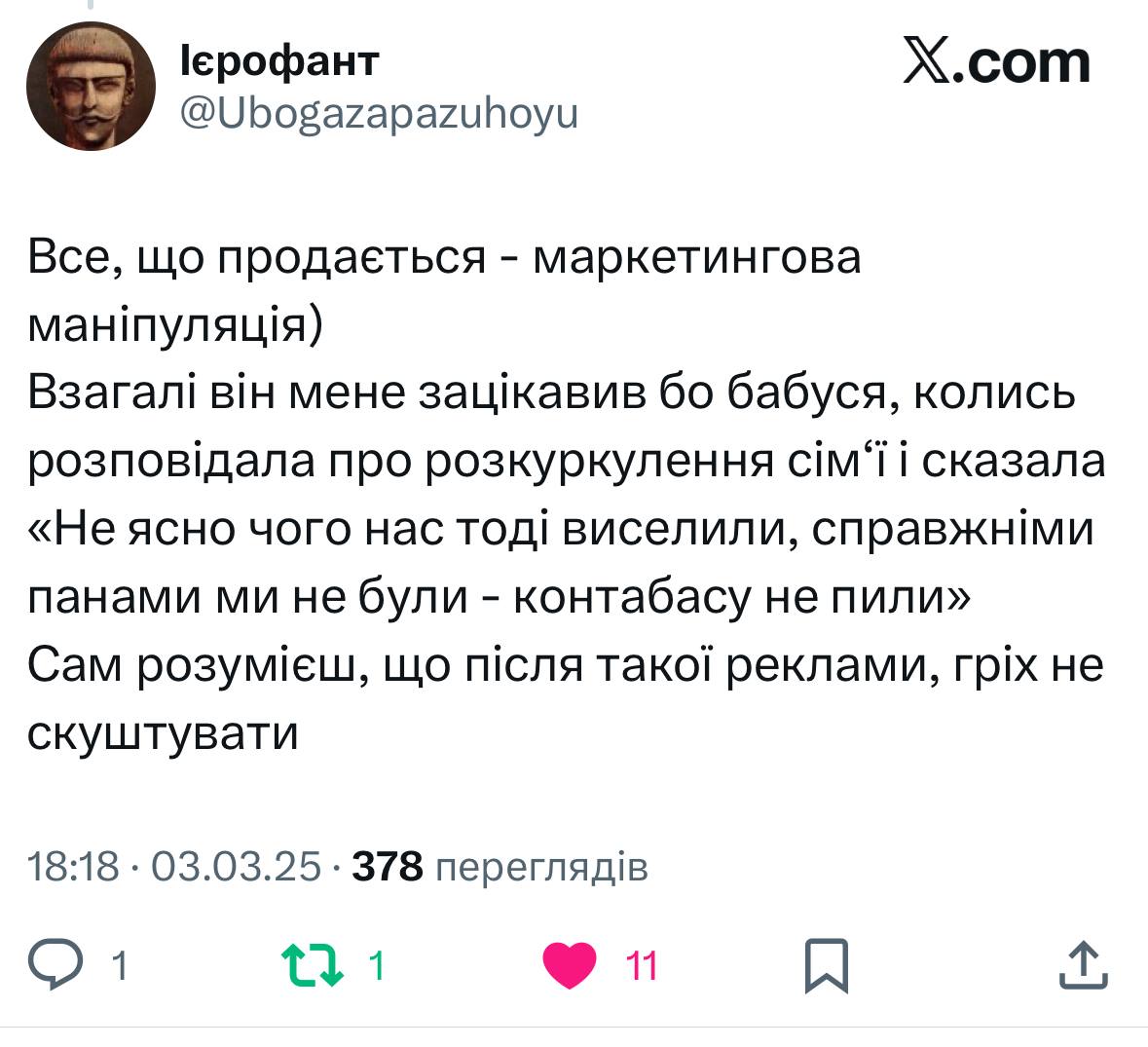
Screenshot from X
And most importantly – there are no analogues. For example, the beverage “starka” (a vodka aged in an oak barrel) exists in Ukraine, Lithuania, Poland and some other countries. But kontabas is purely an Ukrainian beverage. It does not exist anywhere else.
– Have you encountered counterfeits of your product?
– I wouldn’t say outright counterfeits. And how would someone even counterfeit our product? Someone might find a recipe online – for example, from Zynoviia Klynovetska – and make their own product based on it.
– I mean, have they used something similar to your label or trademark?
– There was a case where someone made something very similar: a similar bottle, colors, label. But all of that is difficult to prove.
– And do they also call it “kontabas”?
– Yes. But I cannot register the word “kontabas” as exclusively mine. It’s like “beer” or “vodka” – it’s the name of a beverage. I registered everything that can be registered. But not the word itself – and that would be wrong anyway, because it is a Ukrainian national beverage.
– You have registered trademarks, an industrial design (the label) and even copyright for the recipe. Why did you decide to register all of this?
– With the label and the logo, everything is obvious – so they won’t be stolen. The graphic spelling of “kontabas” is a unique thing and it must be protected. Our designers worked seriously on it: they spent two months studying historical fonts. It was a lot of work.
In general, I understood that registration was necessary. Because tomorrow someone could come and simply copy everything. If nothing is registered, you cannot prove anything. So we protected everything we could to the maximum.
– So you could say that registering intellectual property protects your business?
– Of course, it’s insurance. It’s insurance so that when your business reaches a certain level, you don’t suddenly have a kind of “Abibas” appear next to your “Adidas.” In other words, someone might write “kontabas,” but they won’t be able to use the same font as mine, because it is registered.
And creating a different font already requires effort – you need to find a calligraphy specialist who understands it. In this regard, I was lucky: I found a person who initially didn’t know much about it but learned in the process and did a high-quality job.
So yes, it is very important. By registering your brand and a unique label design, you essentially set “mines” for those who might want to copy you.
I have nothing against someone creating their own trademark, going through the entire process, preparing documents, designing their own logo and producing kontabas. I am against simply copying, pouring something unclear into a bottle and selling it as a premium product.
That’s why everything should be registered – and the earlier, the better.
– Roman, you continued to develop your business after your military service. What motivates you to keep moving forward after everything you’ve been through?
– It is exactly those events that motivate me. After what you experience in war, you ask yourself many times: why did God let me live and why am I still here? It means I still have something to do. And you realize: you didn’t finish kontabas back then – so you have to finish it (smiles).
– How did the war affect your business?
– I would even say partly positively. Many people began turning to Ukrainian history. Before, sales were not large and we were not that well known. But after 2022, people began returning to the language, traditions and awareness of themselves as a nation. And when people start being interested, social media algorithms show them relevant content – and we got into that stream.
This was especially noticeable in 2022–2023, when people were interested in everything: Ukrainians, traditions, beverages, cuisine, clothing. It helped us a lot that we became part of this mainstream.
But there is also a downside – people have less money during the war and that affects business too. So there are both positives and negatives.
– But you’re not going to abandon this, right?
– No, there’s nowhere to abandon it anymore (smiles). Back in 2018, when we found kontabas and the recipes and then in 2019 when we explored the archives, I realized: giving this up would be like a betrayal.
The thought was: essentially, I’m the only one who found this and knows about this ancient Ukrainian beverage. If I abandon everything and don’t tell at least Ukrainians – and at most the whole world – about kontabas, it would be a betrayal. It would be like trampling on Ukrainian history and traditions. So we decided to continue working and producing the beverage. And my family supported me a lot.
– Why is kontabas valuable for Ukrainians – that’s clear. But what about the international market? You are entering it, right?
– Yes. In fact, a distributor is texting me right now (smiles). I’ll reply later.
As for the international market, there is an interesting feature. For example, in the United States, blackcurrant was effectively banned until 2000. So most Americans simply don’t know this taste.
When a Ukrainian drinks kontabas, they understand that it is the taste of blackcurrant. But an American does not. For them, it is a delicious, unique beverage unlike anything else. If rum or whisky feels somewhat familiar to an American, kontabas is something completely alien.
And they like it. They call it a “specialty alcohol” – a special beverage, not cheap, but unique, interesting and worth trying.
The most common feedback in Europe and the US is: “I’ve never tasted anything like this.” And it can be either “wow” or “this is strange,” but in any case – it is a unique experience. There is a niche in the world for flavors that are unlike anything else and we fit into that niche.
When we were at an exhibition in the US, we were told a story about tequila: when tequila producers entered the American market, Americans didn’t know what it was either. But the producer emphasized that it was unlike anything else. Americans tried it and realized it was indeed something completely new. And now tequila is one of the top-selling categories in the US.
Americans like unique things, especially tasty ones. And there are also people there who support Ukraine. So it is possible to reach them. We have already started this journey. It will not be fast or easy – it will require a lot of time and resources – but the first steps have already been taken.
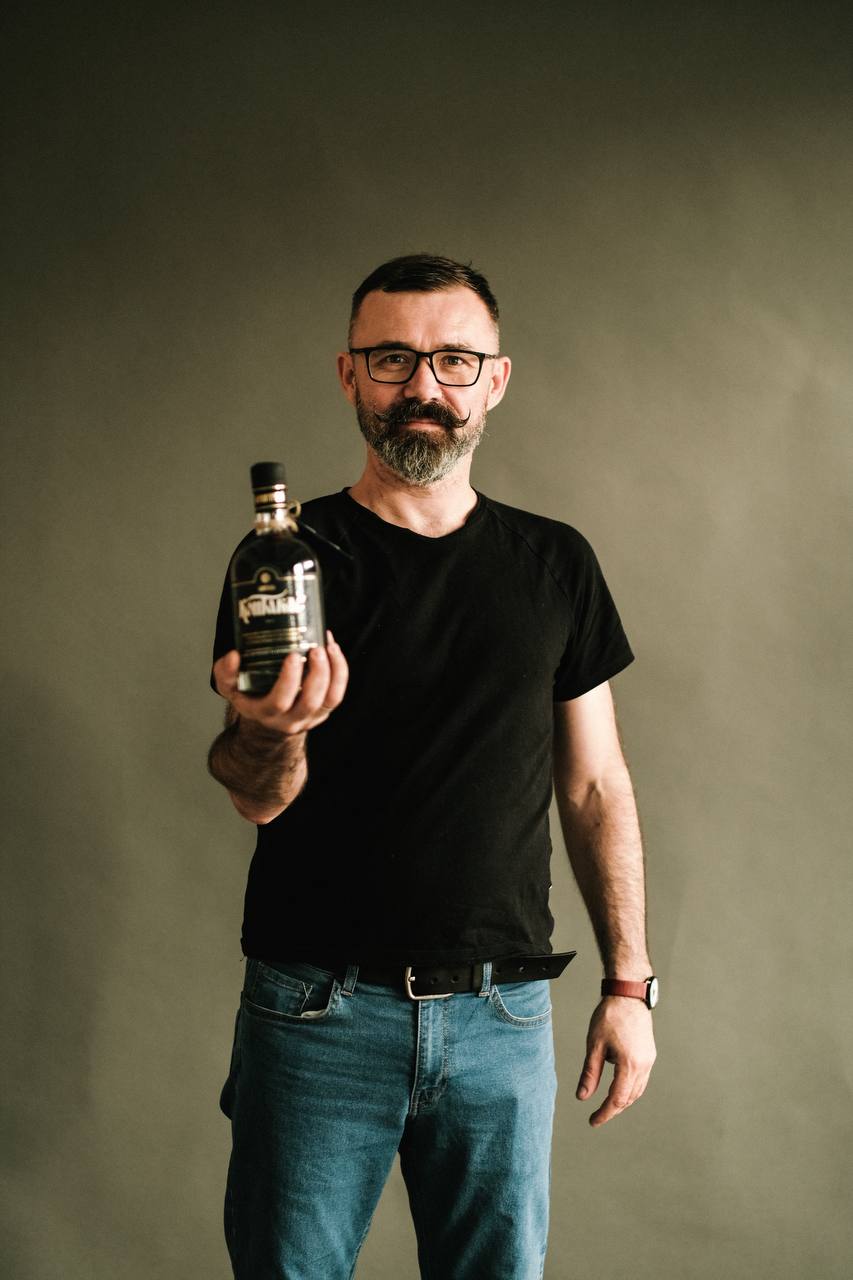
Roman Pelekh and his “Kontabas”
– Are you focusing more on the US or Europe?
– We would like to enter the US market more. Because Europe usually picks up trends from America. If something becomes popular there, it quickly becomes popular here as well.
However, the United Kingdom, by the way, is one of the largest consumers of blackcurrant in Europe. The British enjoy gin and whisky with blackcurrant. So we also see potential there.
If we establish ourselves in the US and show strong sales and positive reception, we will move to Europe. That’s the strategy – we’ll see if it works (smiles).
– So you started with a trump card.
– Yes (smiles). From Ukraine straight to America, not Europe.
– Do you attract investors?
– We do attract investors, but we approach it very carefully. We have one investor who owns 10%. In total, we planned to sell 40%, but we turned down those who approached us for various reasons: sometimes political factors, sometimes because a person wants to invest 100 today and take out 200 tomorrow.
We are looking for investors, but ones like us – who invest in the future.
And considering that we will hopefully enter the US market and then Europe, in the next 4–5 years we expect to be in a very strong position.
So the money invested now can yield a hundredfold return in 2–3 years. But it’s about trust, honesty and transparency. We are fully transparent and pay all taxes. We are prepared for investors to come in, but at the same time we are very selective.
– Roman, based on your experience, what advice would you give to entrepreneurs who are just starting to create craft products?
– First of all – don’t make “Ukrainian whisky,” “Ukrainian gin,” “Ukrainian tequila,” or anything like that. There are hundreds of great Ukrainian alcoholic beverages that can be revived and, with modern technologies, made even better.
And also – focus on quality and don’t be afraid to sell at a high price. That’s it.
– Do you feel that you have already brought forgotten tastes back to Ukrainians?
– I think partially, yes. As I said, we are not stopping. If we had more resources, we would launch a large-scale production facility for multiple beverages at once. Since our financial resources are limited – because we need to produce kontabas, invest in new products and constantly refine technologies – we are moving step by step.
We will do it, it just takes time. Everything takes time.
– How many new beverages do you plan to add to your product range?
– There are 3–4 that I would start producing right away. They are very interesting beverages. There are serious challenges in producing them, but kontabas was not easy either and we managed. So I think we will handle these as well. I won’t say more for now (smiles).
– Alright, we wish you every success.
Photos provided by Roman Pelekh.
For reference:
IPeopleUA is a project of the Ukrainian National Office for Intellectual Property and Innovations (UANIPIO/IP Office) about people who create intellectual property and those who help register it, ensure its protection and defend it.
IPeopleUA aims to reveal the meaning and value of IP through the stories of Ukrainians, as well as to demonstrate how intellectual property works in real life: help to develop creativity, build reputation, scale businesses, enable commercialization and preserve intellectual heritage.
The stories in the project highlight creators, inventors, innovators, founders of brands and startups, scientists, patent attorneys, IP lawyers and other representatives of the intellectual property field. Each of them discovers intellectual property in their own way: through creativity, innovation, business, science, family craft or profession.
If you have stories related to intellectual property that you would like to share, please write to us..
Read also:

No Comments